
Where the duct core holds up and only the wrap failed, a technician can add or replace insulation and seal the jacket. Wet, matted wrap usually comes off entirely, and runs with soaked liners or rusted metal need replacement.
Service · Santa Ana, CA
Duct Insulation Problems in Santa Ana, CA
Water spots spread on the ceiling under a duct run, supply air arrives lukewarm on a hot day, or the jacket around an attic duct hangs in shreds. Duct insulation problems in a Santa Ana home let attic heat soak into your cooling air and let moisture condense on cold metal. If water drips from a ceiling near a light fixture or outlet, switch off the cooling and that circuit's breaker, then call.
What you are seeing
Signs your duct insulation has failed
Insulation failures show up as either heat or water. You feel the heat at your grilles and see the water on ceilings and duct surfaces.
- Lukewarm supply air
cooling air that feels mild at the far grilles though the air handler runs cold.
- Ceiling spots
stains or drips under a run during sticky summer weather.
- Sweating metal
beads of water on bare ducts or fittings in a garage.
- Shredded jackets
the outer plastic sleeve torn, sun-faded near attic vents, or chewed open.
- Matted wrap
fiberglass wrap squeezed flat where straps, boxes or feet have pressed it.
If water drips near a light, fan or outlet, switch that circuit and the cooling off; otherwise map the stains and call.
(714) 386-7626How it works
How heat and humidity get past the wrap
A cooling duct carries air far colder than a summer attic. Insulation slows the heat flowing in, and the vapor jacket keeps humid attic air off the cold inner surface.
- Thermal loss
thin, compressed or missing wrap lets roof-space heat warm the air before it reaches your rooms.
- Condensation
where humid air touches a surface below its dew point, water beads and drips.
- Torn vapor jacket
moist air slips under the sleeve, soaks the fiberglass and cuts its insulating value.
- Bare fittings
uninsulated elbows, boots and plenum corners sweat first.
- R-value
a rating of resistance to heat flow; older runs often carry thinner wrap than newer attic runs.
Technique
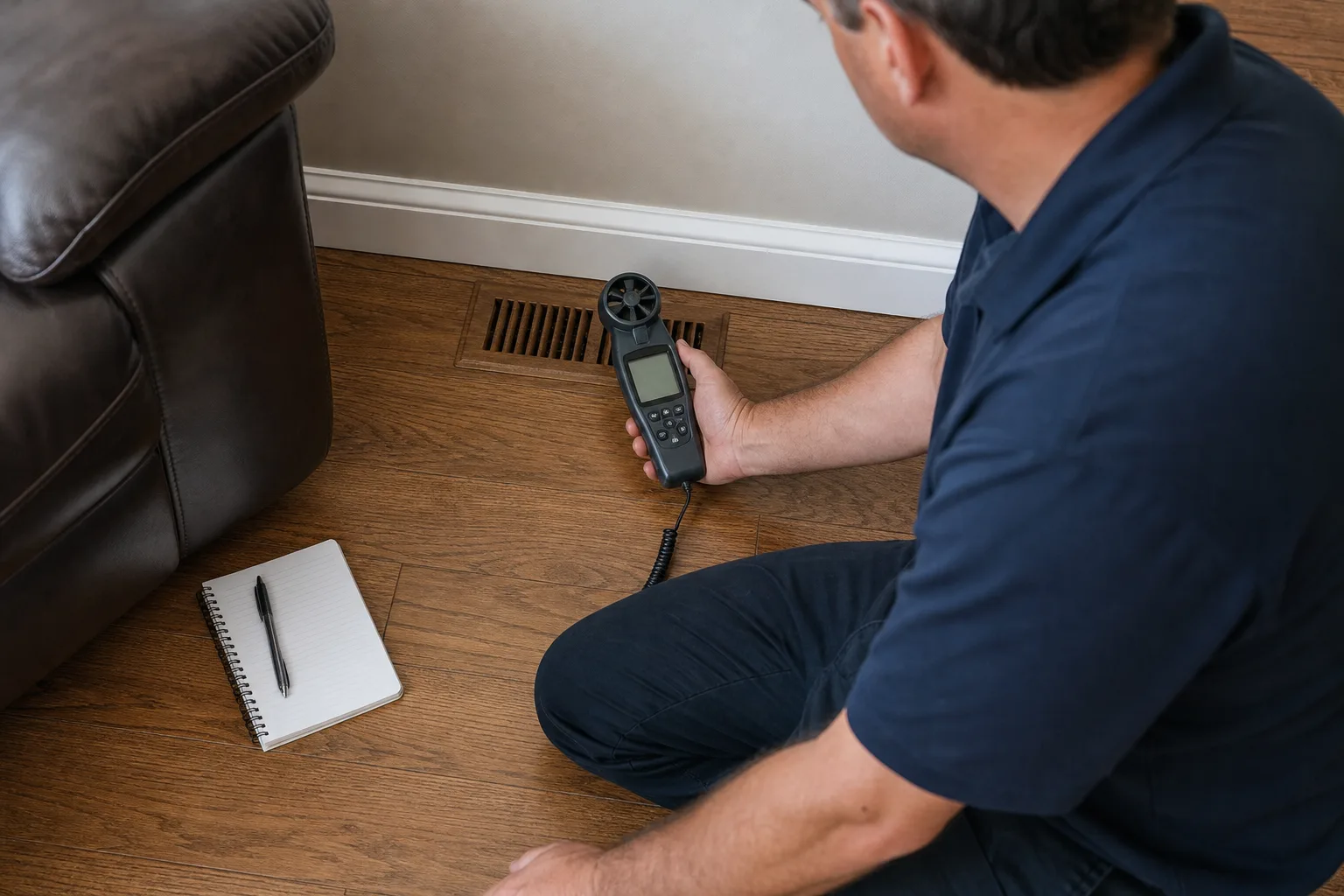
Notes worth taking before you call
Map the stains
Note each ceiling spot and whether it sits under a grille or along a run.
Time the drips
Record whether drips appear on muggy afternoons or only after long cooling runs.
Compare grilles
Feel your nearest and farthest supply grilles and note any that run noticeably milder.
Check exposed ducts
Look at garage or closet ducts for beads of water or a torn sleeve, without pulling at the wrap.
Keep away from loose fiberglass and soaked drywall. Wet ceiling board can give way, and glass fibers irritate skin and lungs.
Safety protocol
Drips near fixtures and fans
Condensate dripping through a ceiling can reach light fixtures, ceiling fans and junction boxes. Treat any drip near electrical parts as a safety problem first.
- Drip at a fixture
switch the light off at the wall and the cooling off at the thermostat.
- Bowing ceiling
keep everyone out from under it and move valuables aside.
- Buzz or flicker
leave the breaker for that circuit off until a technician has looked.
Triage order
Rewrap the run or replace it
Phase order
What failed insulation leads to
Each humid stretch adds more water to the drywall, and soaked ceiling board stains, softens and eventually sags. Meanwhile heat gain through the wrap keeps your cooling cycles running longer than they should.
Calling at the first ceiling spot keeps the repair to the duct and spares you a drywall repair too.
Local detail
Humid spells and attic ducts in Santa Ana
A muggy stretch in a Santa Ana summer is when weak duct insulation shows itself first. Tell the technician where stains appear in your Orange County home and whether they follow sticky weather.
Scope: Residential heating, cooling and ductwork diagnostics, repairs, tune-ups and replacement. Scope and pricing are provided directly by the contractor you hire.
Service area
Santa Ana ZIP codes
- 92701
- 92703
- 92704
- 92705
- 92706
- 92707
Every responding technician is independent. Before work begins, confirm the technician's license, insurance and pricing with them directly.
Common questions
Duct insulation questions
Why do ducts sweat?
Cold supply air chills the duct surface below the dew point of the surrounding air. Without an intact jacket and wrap, moisture condenses on the metal and drips.
Does a sweating duct mean your AC runs too cold?
Usually not. Supply air leaves the coil at a normal cooling temperature; missing wrap or a torn jacket lets humid air reach the metal. Raising the thermostat setting rarely stops the drip.
Can new insulation go over old wrap?
Sometimes, if the old wrap stays dry and the jacket holds. Wet or matted wrap traps moisture, so it comes off first.
Does duct insulation matter for heating too?
Yes. In winter, poorly wrapped runs lose furnace heat to a cold attic, so your far rooms warm slowly.
A heating or cooling fault rarely fixes itself.
Call and describe the problem in Santa Ana: what the system is doing, what it did first and how old the equipment is.