
Refrigerant does not burn off or wear out the way fuel or motor oil might. It circulates in a closed loop between the indoor coil and the outdoor condenser, absorbing heat inside and shedding it outside, so a low charge always means some of it has escaped.
Service · Santa Ana, CA
Low Refrigerant and AC Leaks in Santa Ana, CA
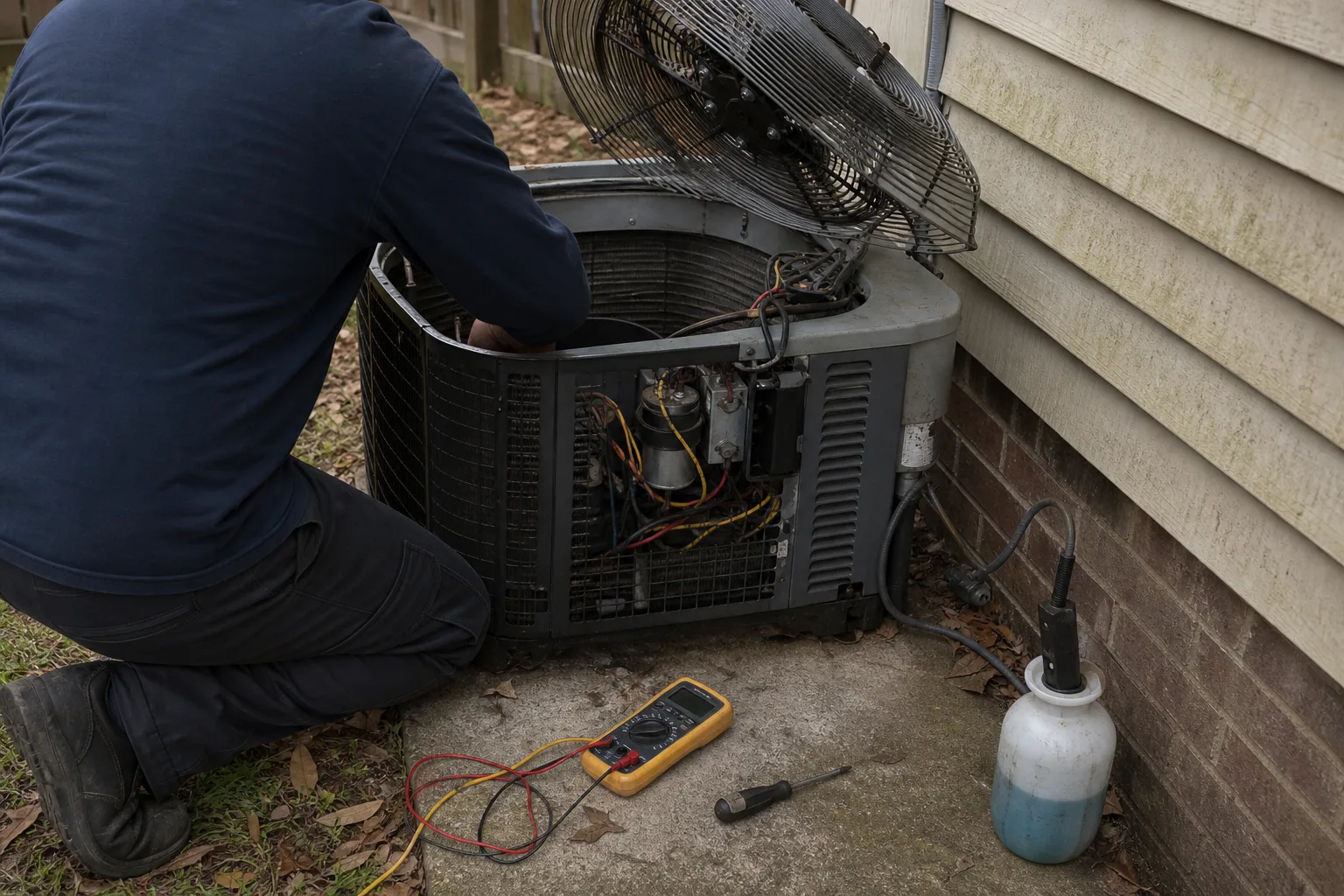
Your AC has been losing cooling power over days or weeks, the copper line at the outdoor unit frosts over, or you hear a faint hiss near the coils. Low refrigerant and AC leaks go together: the refrigerant circuit is sealed, so the charge only drops when it escapes through a leak in the coils, joints or lines. Switch the system off and keep your hands away from the refrigerant lines and service ports.
What you are seeing
How a refrigerant leak shows up
- Fading cooling
your system runs longer and longer while the house stays a few degrees warmer than the setting.
- Ice on the suction line
frost on the larger copper pipe at the outdoor unit or on the indoor coil.
- Hissing or bubbling
a faint sound near the coils or the line set while the compressor runs.
- Oily residue
refrigerant carries oil, so a leak often leaves a greasy, dust-caked spot at a joint or coil bend.
- Clammy rooms
a starved coil pulls less moisture from the air, so humidity climbs indoors.
How it works
Why refrigerant never just runs low
Common leak points include vibration-worn copper joints, tubing that rubs against the cabinet, corroded indoor coils with pinhole leaks, and loose valve cores at the service ports. A small leak can take weeks to show; a larger one empties the circuit within a season.
Switch the system off, leave the refrigerant lines alone, and call with the signs you noticed.
(714) 386-7626Safety protocol
Hands off the refrigerant circuit
Leave the service ports, valve caps and line set alone. Federal EPA rules under Section 608 restrict refrigerant handling to trained technicians, and the refrigerant itself can cause frostbite on contact and displace oxygen in a closed space.
Canned products sold for car air conditioners do not belong in a home system. They can contaminate the circuit, mask the leak and leave the real fault in place.
Switch the system off: running short of charge strains the compressor.
Open windows if you notice a sweet chemical odor indoors, and keep people out of a closed mechanical room.
Keep children and pets away from an iced or hissing line.
Technique
What finding the leak involves for you
Leak diagnosis means testing, not guessing: pressure and temperature readings, an electronic detector, bubble solution, dye or a nitrogen pressure test. The repair follows the location, from a brazed joint or a new valve core to a replacement coil when corrosion has spread.
Note the timeline
When did cooling start to fade, and did it fade gradually or all at once?
Note the history
If the system has needed refrigerant before, the leak has likely been there a while; say so on the call.
Photograph the residue
A picture of an oily spot on a joint or coil helps narrow the search.
Phase order
Why a slow leak does not stay small
A short-charged system runs longer, ices its coil, and starves the compressor of the cool returning vapor and oil that protect it. The compressor then runs hot, and a leak a brazed joint could have fixed becomes a compressor failure.
Each week you keep running it adds wear and lets more refrigerant escape. Switching off and calling while cooling is merely weak keeps the repair at the leak stage.
Local detail
Mild days hide slow leaks
In Santa Ana, a slightly undercharged system can still keep up on mild days, so a slow leak often hides until the first stretch of real heat in Orange County. If your AC struggled from the first hot week, mention it; that suggests the charge dropped over the cooler months.
Scope: Residential heating, cooling and ductwork diagnostics, repairs, tune-ups and replacement. Scope and pricing are provided directly by the contractor you hire.
Service area
Santa Ana ZIP codes
- 92701
- 92703
- 92704
- 92705
- 92706
- 92707
Every responding technician is independent. Before work begins, confirm the technician's license, insurance and pricing with them directly.
Common questions
Refrigerant leak questions in Santa Ana
Can an AC lose refrigerant without a leak?
No. The circuit is sealed, so refrigerant does not get used up. A low charge always means it escaped somewhere, and the leak keeps going until someone repairs it.
Is it dangerous to be near a refrigerant leak?
In open air, small leaks pose little risk, but refrigerant can freeze skin and displace oxygen in a small closed room. Air out the area and stay clear of iced or hissing lines.
Why does the leak have to be found before anything else?
Refrigerant that escaped once keeps escaping. Restoring the charge without a repair only hides the fault for a while, and federal rules limit refrigerant handling to trained technicians for good reason.
A heating or cooling fault rarely fixes itself.
Call and describe the problem in Santa Ana: what the system is doing, what it did first and how old the equipment is.