
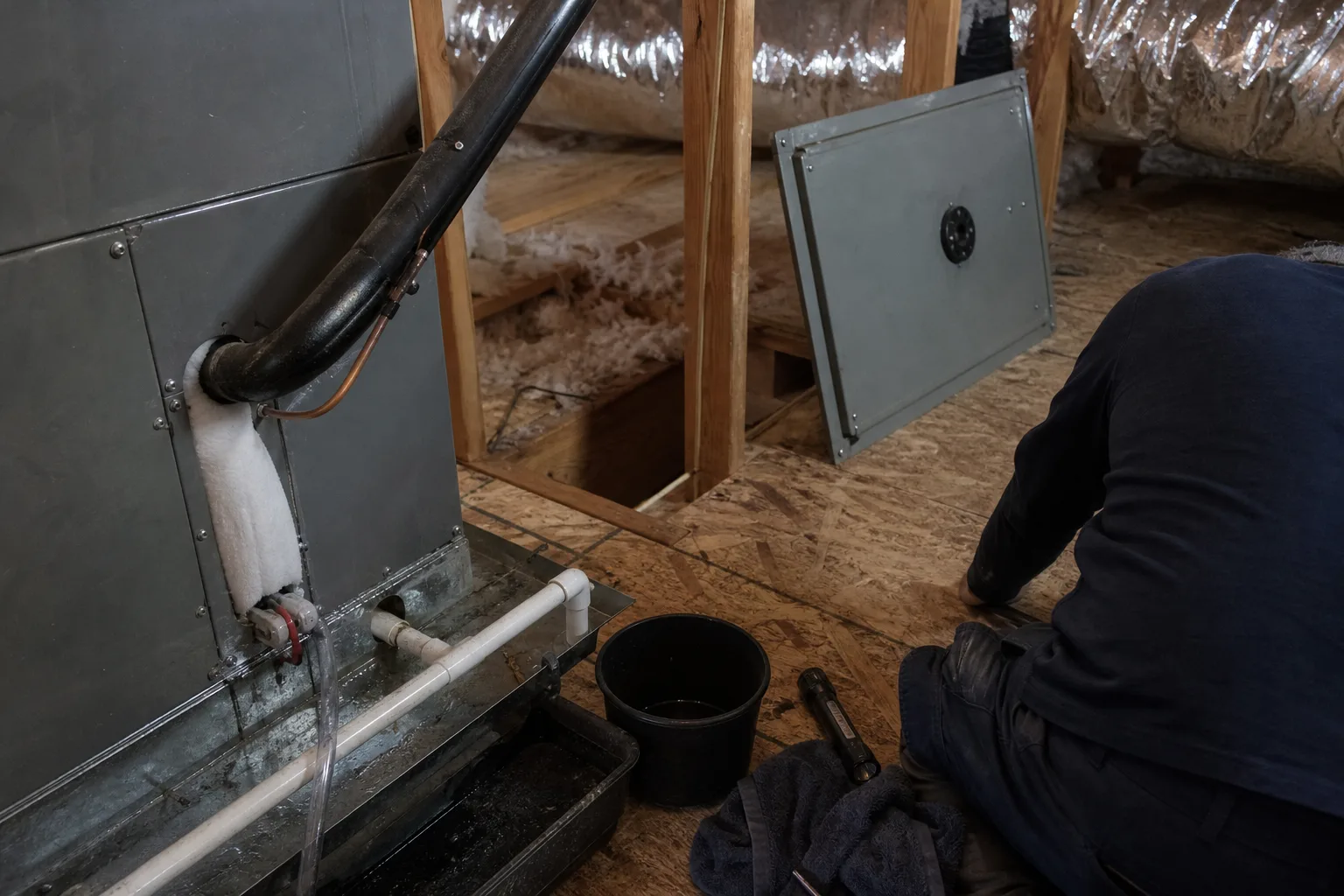
The first clue is often a thin crust of frost on the larger, insulated copper pipe where it enters the outdoor cabinet, or an icy, sweating line near the furnace closet or attic air handler. Airflow from your registers drops at the same time, because ice blocks the coil.
Service · Santa Ana, CA
Frozen AC Coil / AC Leaking Water in Santa Ana, CA
You find ice on the copper line by the outdoor unit, frost on the indoor coil, or water leaking from the air handler onto the floor or through a ceiling. A frozen AC coil and an AC leaking water are often one problem at two stages: the coil ices over, then the ice melts faster than the condensate pan can hold it. Switch the cooling off now and protect anything electrical near the water.
What you are seeing
Ice first, then a puddle
Later the water shows up: a soaked filter, a puddle around the indoor cabinet, or a brown stain spreading across a hallway ceiling. Where the air handler sits in an attic, that stain is often the first sign anyone notices.
Shut the cooling off, keep water away from the wiring, then call and describe where the ice or water appeared.
(714) 386-7626How it works
Why a cooling coil turns to ice
Your evaporator coil runs just above freezing by design. Warm house air crossing it keeps the surface from dropping lower; take away that air, or lose refrigerant pressure, and the coil falls below freezing while the moisture it pulls from your air turns to ice.
- Choked airflow
a clogged filter, shut registers or a failing blower motor leaves too little warm air crossing the coil.
- Refrigerant loss
a leak lowers pressure inside the coil, which lowers its temperature until frost forms.
- Dirty coil fins
a film of dust insulates the coil and narrows the gaps air must pass through.
- Blocked condensate path
the AC drain line or pan backs up, the float switch trips or fails, and meltwater spills past the cabinet.
Technique
Thaw the coil and catch the water
Shut off cooling
Set the thermostat to off so the compressor stops making more ice.
Run the fan alone
Switch the fan setting to on, unless water has reached the cabinet's wiring; then leave everything off at the breaker.
Protect the area
Put towels or a shallow tub under the drip, move boxes and furniture, and keep water away from outlets and extension cords.
Fit a clean filter
A fresh filter lets airflow return once the coil thaws.
Never chip or scrape the ice. Coil fins and copper tubing tear easily, and a puncture turns an airflow fault into a refrigerant leak.
Leave the condensate line, the pan and the float switch to the HVAC technician. They belong to the cooling equipment, and clearing them means opening the cabinet.
Phase order
Before you restart cooling
A coil that iced once will ice again unless the cause changes. Restarting cooling while frost still clings to the line refreezes the coil sooner, and liquid refrigerant can flood back to a compressor that only pumps vapor safely.
Wait until the line and the coil look completely clear and dry, then call before you run cooling again. If water reached a ceiling, the drywall can keep dripping and sagging, so keep the room below clear.
Local detail
Where your indoor unit sits matters
If your Santa Ana home keeps its air handler in the attic, an overflowing pan drains straight into the ceiling below; in a hall closet or garage, the water reaches floors and walls instead. Say where your unit sits when you call, since Orange County homes vary widely in how builders placed the equipment.
Safety protocol
Water near wiring and ceilings
- Water on the control board or wiring
switch the air handler breaker off and leave it off.
- Sagging ceiling drywall
keep people out of the room below, because a soaked panel can drop without warning.
- Water around a gas furnace cabinet
leave the furnace off as well and keep the burner area dry.
Tell the technician where the ice formed, where the water landed, and when you last changed the filter.
Scope: Residential heating, cooling and ductwork diagnostics, repairs, tune-ups and replacement. Scope and pricing are provided directly by the contractor you hire.
Service area
Santa Ana ZIP codes
- 92701
- 92703
- 92704
- 92705
- 92706
- 92707
Every responding technician is independent. Before work begins, confirm the technician's license, insurance and pricing with them directly.
Common questions
Ice and leak questions from Santa Ana
Should you run the AC fan when the coil has iced over?
Yes, with cooling off and no water near the wiring. The fan pulls warm air across the coil and speeds the thaw; if water has reached electrical parts, leave everything off instead.
Why does an AC leak water only after it freezes?
Ice holds the condensate on the coil. As it melts, it releases far more water at once than the pan and the condensate line can carry, so the overflow spills past the edge.
Is a frozen coil a sign of low refrigerant?
Sometimes. Airflow faults freeze coils more often, but a slow leak can do the same, and only a technician with gauges can tell which. Mention whether a fresh filter made any difference.
A heating or cooling fault rarely fixes itself.
Call and describe the problem in Santa Ana: what the system is doing, what it did first and how old the equipment is.