
An overheating motor or a shorted capacitor keeps drawing current until the breaker trips, and a worn breaker may not trip at all. Insulation softens, terminals blacken, and nearby wiring can ignite; cutting power removes the fuel for that chain.
Service · Santa Ana, CA
Emergency AC Repair in Santa Ana, CA
Your AC has failed and the situation feels urgent: smoke or sparks at a unit, water pouring onto wiring, or a house heating up around an infant, an older relative or someone with a medical condition. Emergency AC repair starts with sorting real danger from discomfort, because the first steps differ. If you see smoke or flames, leave the house and call 911 first.
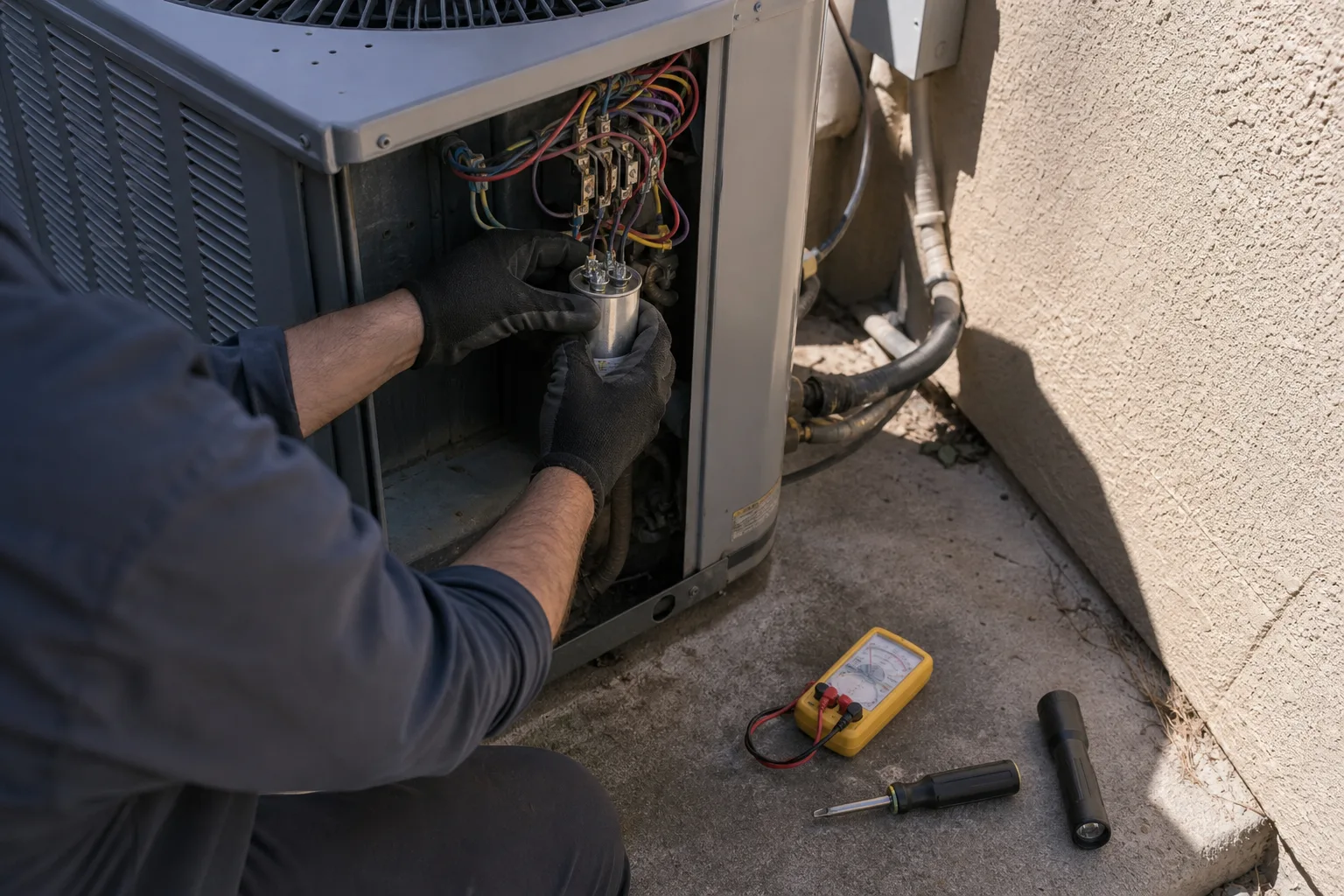
What you are seeing
What makes an AC failure an emergency
- Fire risk
smoke, sparks, scorch marks or a melting smell at the outdoor unit, the indoor cabinet or the electrical panel.
- Electrical exposure
water dripping onto the air handler's control board, or a breaker that trips again the moment you reset it.
- Heat risk to people
indoor temperatures climbing with a baby, an elderly person, a pregnant family member or anyone on heat-sensitive medication at home.
- Property risk
a ceiling bulging with condensate or water spreading across floors.
An AC that simply stopped cooling on a mild evening, with nobody vulnerable at home, still deserves a call, just with less alarm. Switch it off either way.
Once the power is off and everyone is safe, call and lead with the danger you saw.
(714) 386-7626Safety protocol
Make the house safe first
Cut power
Set the thermostat to off, then flip the AC and air handler breakers at the panel if anything smells hot or looks scorched.
Get clear of smoke
If smoke keeps coming after the power is off, get everyone outside and call 911.
Keep water off electrics
Catch drips in a container and keep people away from any cabinet with water on it.
How it works
Why heat and electrical faults escalate
Indoor heat builds another way. Once cooling stops, walls, roof framing and furniture keep releasing the warmth they soaked up all day, so a closed-up house keeps warming into the evening, and young children and older adults struggle to shed that heat first.
Technique
Keep people cool while the AC is down
- Pick the coolest room
usually a ground-floor room on the shaded side, with blinds drawn on sunny windows.
- Move air across skin
portable fans, damp cloths on the neck and wrists, and cool showers help the body shed heat.
- Drink water steadily
thirst lags behind dehydration, especially for older adults.
- Watch for heat illness
dizziness, confusion, a racing pulse, nausea or hot, dry skin means call 911.
- Relocate if needed
a relative's home, a cooled public building or a cooling center keeps vulnerable people safe until your system runs again.
Phase order
Priorities in the hours after a breakdown
Your priorities run in a fixed order: safety first, people second, equipment third. Once the power is off and everyone is comfortable, an idle system will not grow worse while it waits.
Resist restarting the AC to see if it recovers. A unit that smoked, sparked or tripped its breaker twice can fail harder on the next start, and the damage then spreads to parts that were still sound.
Local detail
Heat-sensitive households in Orange County
On hot stretches in Santa Ana, an AC outage hits hardest in homes with infants, older adults or anyone managing a health condition. If that describes your household, say it first when you call, and keep a cooler place in mind elsewhere in Orange County in case the repair runs long.
Triage order
What to say when you call for emergency AC repair
Lead with the danger: smoke, sparks, water on wiring, or someone at risk from heat. Then give the basics: what the outdoor unit and the thermostat show, which breakers you switched off, and roughly how old your system is.
Scope: Residential heating, cooling and ductwork diagnostics, repairs, tune-ups and replacement. Scope and pricing are provided directly by the contractor you hire.
Service area
Santa Ana ZIP codes
- 92701
- 92703
- 92704
- 92705
- 92706
- 92707
Every responding technician is independent. Before work begins, confirm the technician's license, insurance and pricing with them directly.
Common questions
Emergency AC questions in Santa Ana
When is a broken AC an emergency instead of an inconvenience?
When it threatens people or the house: smoke, sparks, water on wiring, a breaker that trips over and over, or indoor heat endangering someone vulnerable. Otherwise, switch it off and call to describe it.
Should you call 911 or an HVAC technician first?
Call 911 for smoke, fire or signs of heat illness. Once everyone is safe and the power is off, call about the AC.
Is it safe to keep a sparking AC unit running until help comes?
No. Switch it off at the thermostat and the breaker. Sparking means current is arcing where it should not, and every minute it runs adds fire risk.
A heating or cooling fault rarely fixes itself.
Call and describe the problem in Santa Ana: what the system is doing, what it did first and how old the equipment is.